
Abstract
A computer-implemented system and method for automatically extracting structured responsibility and semantic labels from unstructured employment-related documents. The system receives heterogeneous employment documents including resumes, job descriptions, career profiles, and related textual records, and transforms the documents into machine-readable, hierarchically structured responsibility keywords, allowing for fast, structured, accurate, both semantic and business-oriented extraction from the chaotic information generated from the industry. The system comprises a document ingestion module configured to preprocess employment documents; an ontology generation pipeline comprising n-gram summarization, large language model-based topic generation, and hierarchical relationship construction to generate a responsibility ontology; a feature extraction module employing a transformer-based encoder to generate contextual embeddings; an adaptive multi-label prediction engine configured to dynamically determine document-specific classification thresholds; a hierarchical consistency enforcement module configured to preserve semantic relationships among predicted labels; and a structured output generator producing standardized responsibility profiles for downstream employment intelligence applications including document matching, recommendation, candidate evaluation, and analytics. In some embodiments, the disclosed techniques may also be applied to other domains involving unstructured textual documents, including e-commerce, legal services, financial services, and consumer platforms.
Background/Summary
Field
[0001]The present invention relates generally to natural language processing and machine learning systems, and more particularly to computer-implemented systems and methods for automatically extracting structured professional responsibilities from unstructured employment documents using hierarchical ontologies and adaptive multi-label classification techniques.
Background
[0002]The modern employment ecosystem generates vast quantities of unstructured textual data in the form of resumes, job descriptions and professional profiles. These documents contain rich information about professional responsibilities, skills, and competencies, but the unstructured nature of this data presents significant challenges for automated processing, analysis, and matching at scale.
[0003]Existing approaches to extracting information from employment documents generally fall into several categories, each with significant limitations. Keyword-based extraction systems represent the most common approach, wherein predefined keyword lists are matched against document text. However, these systems suffer from semantic blindness—they cannot distinguish between a core responsibility and a peripheral mention, and they fail to capture hierarchical relationships between responsibilities. Furthermore, keyword systems produce flat, unstructured output that cannot represent the nuanced, multi-faceted nature of professional roles.
[0004]Single-label classification systems attempt to assign a single category to each document segment, but professional responsibilities are inherently multi-label in nature. A data scientist may simultaneously engage in "feature engineering," "model development," and "data visualization." Single-label approaches force an artificial exclusivity that misrepresents the actual professional landscape.
[0005]Generic multi-label text classification systems, while capable of assigning multiple labels, treat all labels as independent and equally related. They lack domain-specific ontological structure, cannot enforce hierarchical consistency, and apply uniform classification thresholds across all document types, leading to suboptimal precision-recall trade-offs.
[0006]Transformer-based language models such as BERT and DistilBERT have demonstrated remarkable capabilities in natural language understanding tasks. However, their application to employment document analysis has been limited to generic text classification or named entity recognition, without addressing the specific challenges of responsibility extraction: (1) the need for hierarchical consistency in predictions, (2) the variability in responsibility granularity across different job titles, (3) the requirement for adaptive thresholding to handle documents of varying quality and completeness, and (4) the need for domain-specific responsibility pools that evolve with industry standards.
[0007]Existing patent literature is very rare in this topic. What is more, none of these systems address the combination of: (a) hierarchical responsibility ontologies with parent-child semantic relationships, (b) adaptive multi-label prediction with per-document threshold optimization, (c) title-specific specialized models with curated responsibility pools, and (d) multi-model cloud deployment architecture for scalable inference across diverse professional domains.
Brief Summary of the Invention
[0008]The present invention provides computer-implemented systems and methods for automatically extracting structured professional responsibilities from unstructured employment documents using a hierarchical responsibility ontology and adaptive multi-label prediction.
[0009]In one aspect, the invention provides a system comprising: a document ingestion module 110 configured to receive and preprocess unstructured employment documents including resumes, job descriptions, and performance reviews; a hierarchical responsibility ontology 150 stored in a non-transitory computer-readable medium, the ontology 150 comprising a multi-level taxonomy of professional responsibilities with defined parent-child relationships 260, peer relationships 270, and semantic similarity metrics 280, the ontology 150 generated through a multi-stage pipeline 130 comprising n-gram summarization 510, large language model-based topic generation 520, and hierarchical relationship construction 530; a feature extraction module 140 employing a transformer-based neural network 142 to generate contextual embeddings from preprocessed document text segments; an adaptive multi-label prediction engine 160 configured to output probability scores for each responsibility in a title-specific responsibility pool 720 and to dynamically adjust classification thresholds based on document characteristics; and a structured output generator 180 configured to produce machine-readable responsibility profiles comprising predicted responsibilities, confidence scores, and hierarchical relationships.
[0010]In another aspect, the invention provides a method comprising: receiving an unstructured employment document; segmenting the document into individual responsibility-bearing text units; generating a hierarchical responsibility ontology 150 through n-gram summarization 510 of document text, large language model 522-based topic generation and filtering, and construction of parent-child hierarchical relationships 532; generating contextual embeddings for each text unit using a transformer-based encoder 146; computing responsibility probability scores using a title-specific multi-label classifier 160; determining adaptive classification thresholds based on the distribution of probability scores across the responsibility pool; applying the adaptive thresholds to generate predicted responsibilities; enforcing hierarchical consistency by ensuring predicted child responsibilities imply corresponding parent responsibilities; and generating a structured responsibility profile.
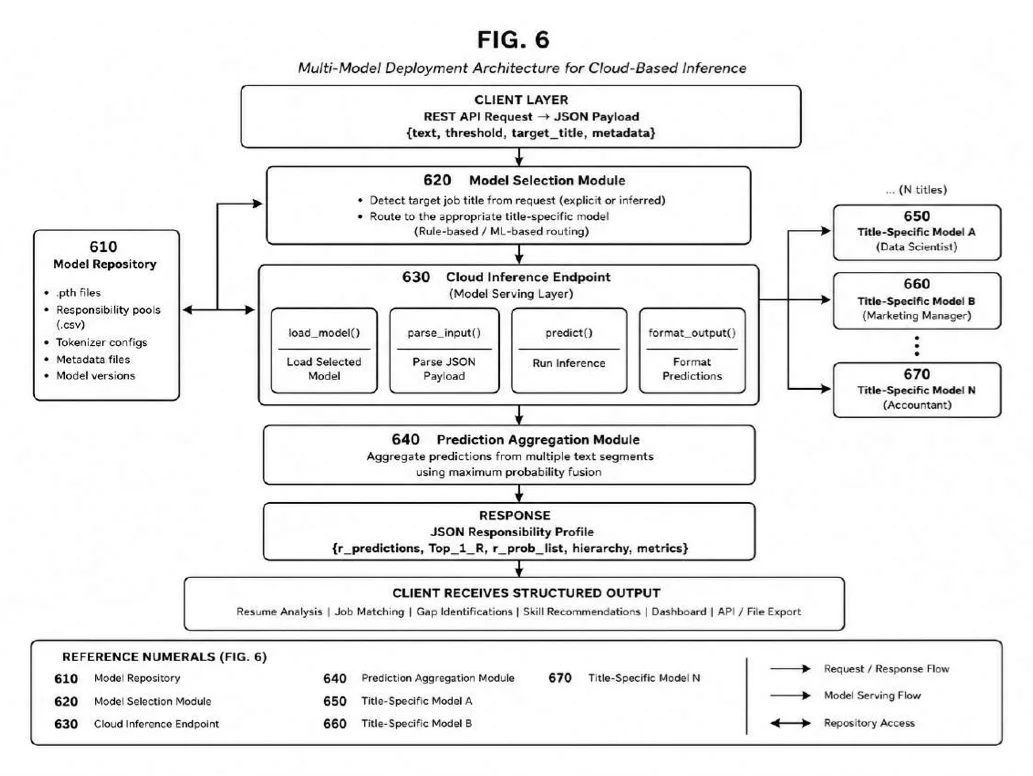
[0011]In yet another aspect, the invention provides a multi-model deployment architecture 190 comprising: a plurality of title-specific prediction models 650, 660, 670, each trained on a curated responsibility pool 720 of 15-25 responsibilities for a target job title; a model selection module 620 configured to route incoming documents to the appropriate title-specific model based on detected job title or user specification; a cloud-based inference endpoint 630 configured to load and execute the selected model; and an aggregation module 640 configured to combine predictions from multiple text segments of a single document using maximum probability fusion.
[0012]The adaptive multi-label prediction engine 160 represents a key innovation, wherein classification thresholds are not fixed but are dynamically computed for each document based on: (1) the overall confidence score distribution across the responsibility pool, (2) the target job title's typical responsibility distribution learned from training data, (3) the document length and completeness indicators, and (4) historical performance metrics for each responsibility class. This adaptive approach significantly improves precision-recall trade-offs compared to fixed-threshold approaches.
[0013]The hierarchical responsibility ontology 150 provides semantic structure to the extraction process, enabling: hierarchical consistency enforcement (parent-child implication rules), semantic similarity-based responsibility clustering, ontology-guided data augmentation during model training, and interpretable output structuring that reflects real-world professional competency hierarchies.
Description of the Drawings
[0014]All together 11 figures will be presented to explain the research workflow, implementation pipeline, evaluation and deployment.
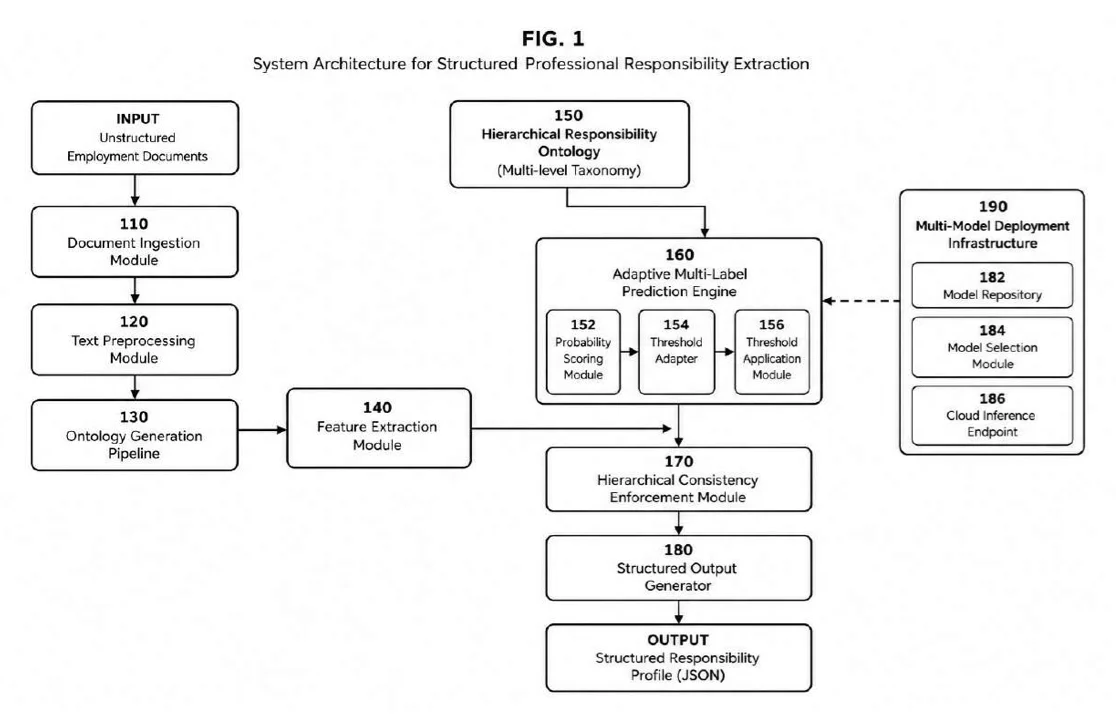
[0015]FIG. 1 is a system architecture diagram illustrating the components of the computer-implemented system for extracting structured professional responsibilities from unstructured employment documents, in accordance with an embodiment of the present invention.
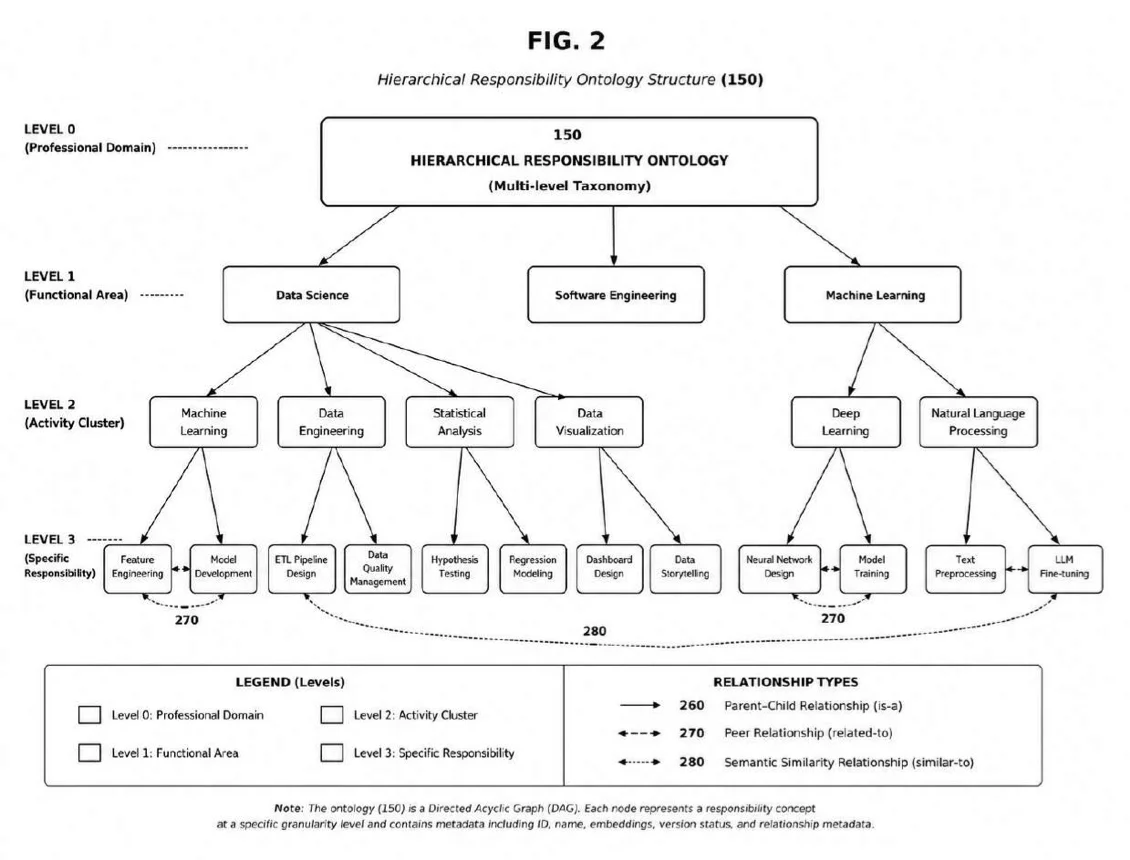
[0016]FIG. 2 is a schematic diagram illustrating the hierarchical responsibility ontology structure showing parent-child relationships between professional responsibilities, in accordance with an embodiment of the present invention.
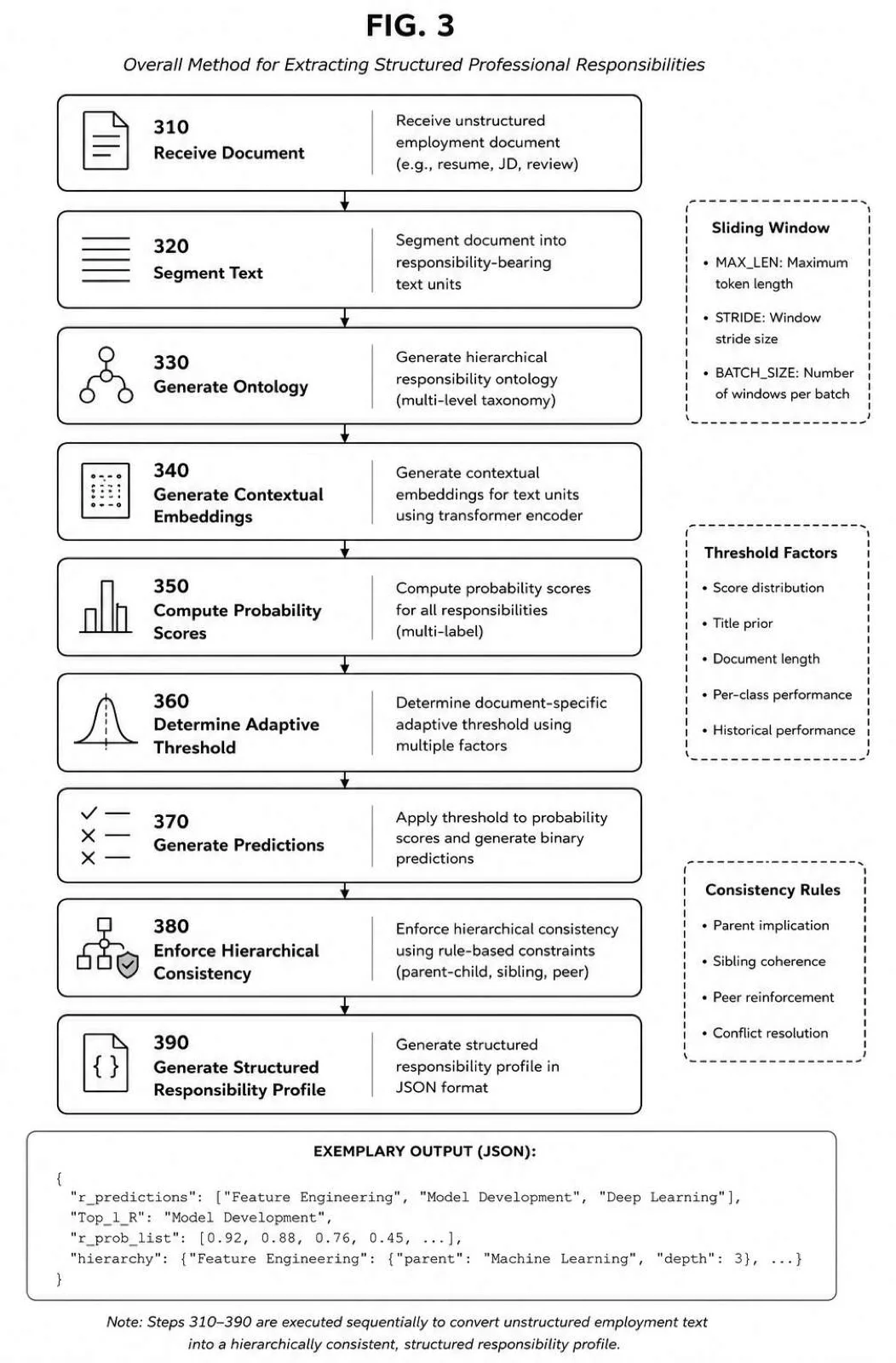
[0017]FIG. 3 is a flowchart illustrating the end-to-end method for extracting structured professional responsibilities from unstructured employment documents, in accordance with an embodiment of the present invention.
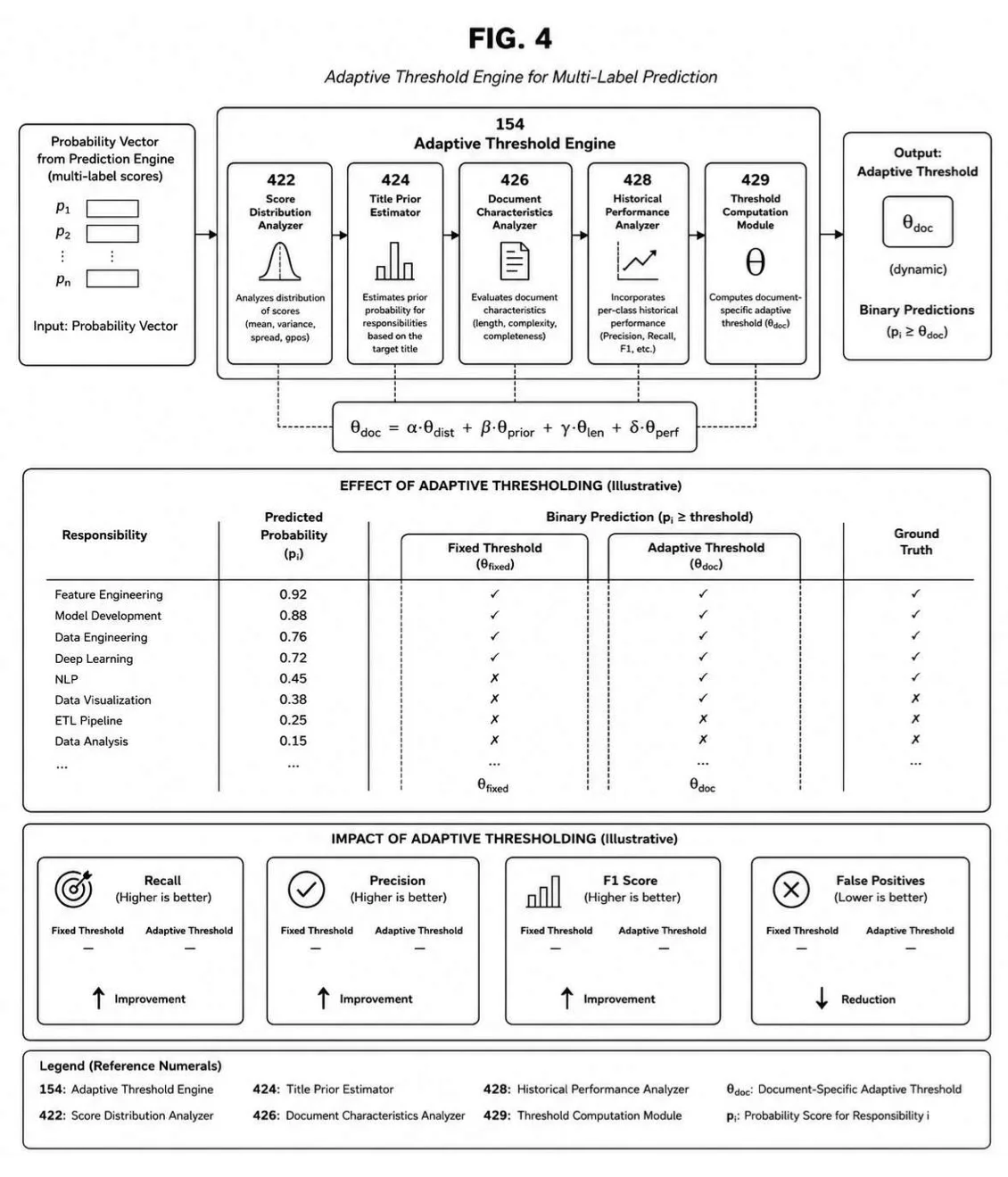
[0018]FIG. 4 is a schematic diagram illustrating the adaptive multi-label prediction mechanism with dynamic threshold adjustment, in accordance with an embodiment of the present invention.
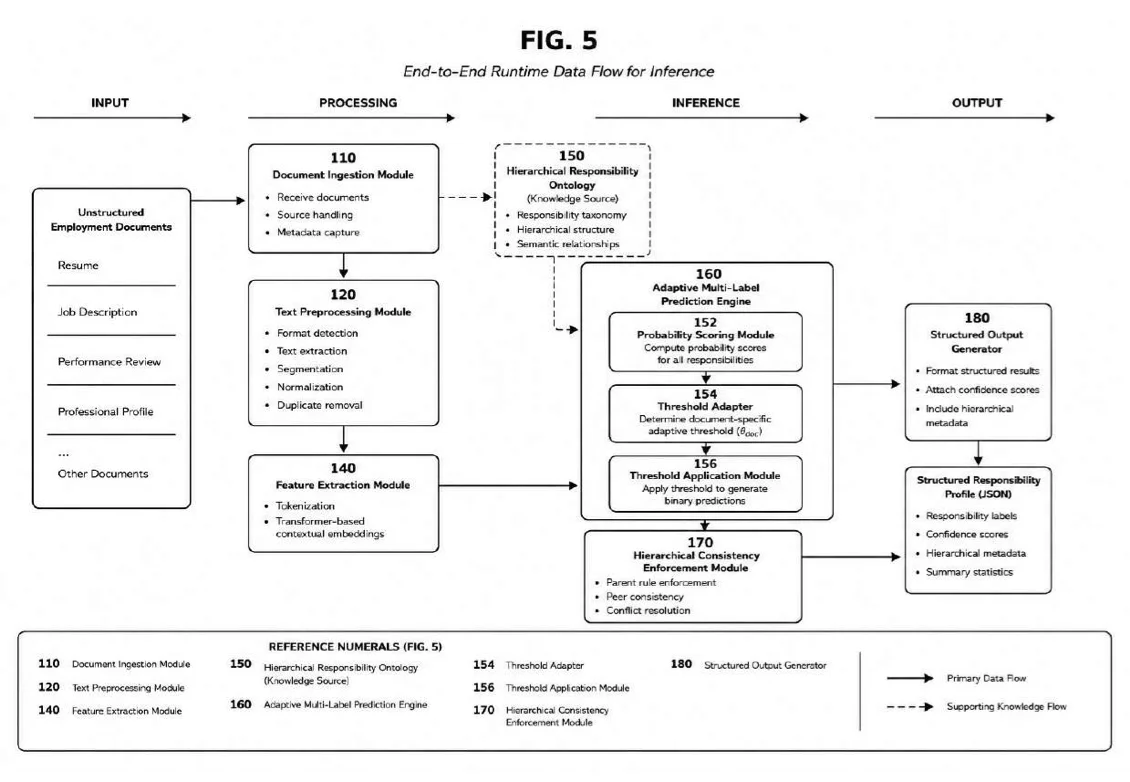
[0019]FIG. 5 is a data flow diagram illustrating the end-to-end runtime data flow for inference from unstructured employment documents to structured responsibility profiles, in accordance with an embodiment of the present invention.
[0020]FIG. 6 is a schematic diagram illustrating the multi-model deployment architecture for cloud-based inference across multiple target job titles, in accordance with an embodiment of the present invention.
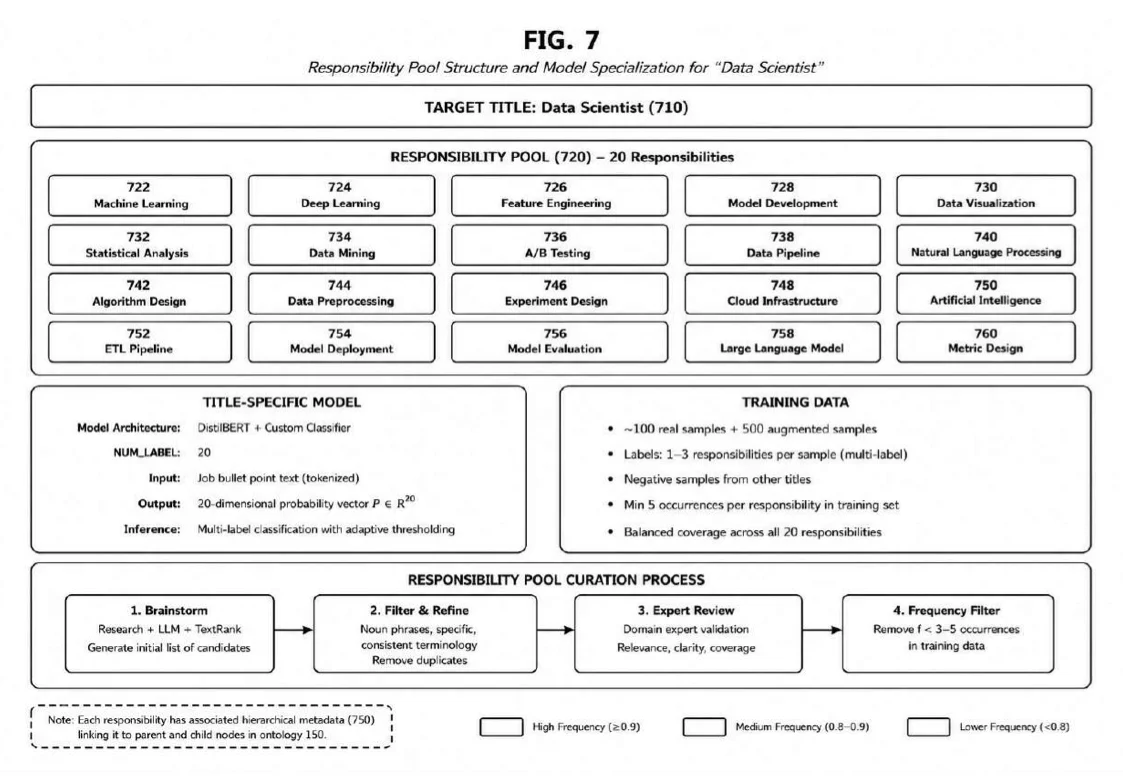
[0021]FIG. 7 is a diagram illustrating the responsibility pool structure and model specialization for a representative target job title, in accordance with an embodiment of the present invention.
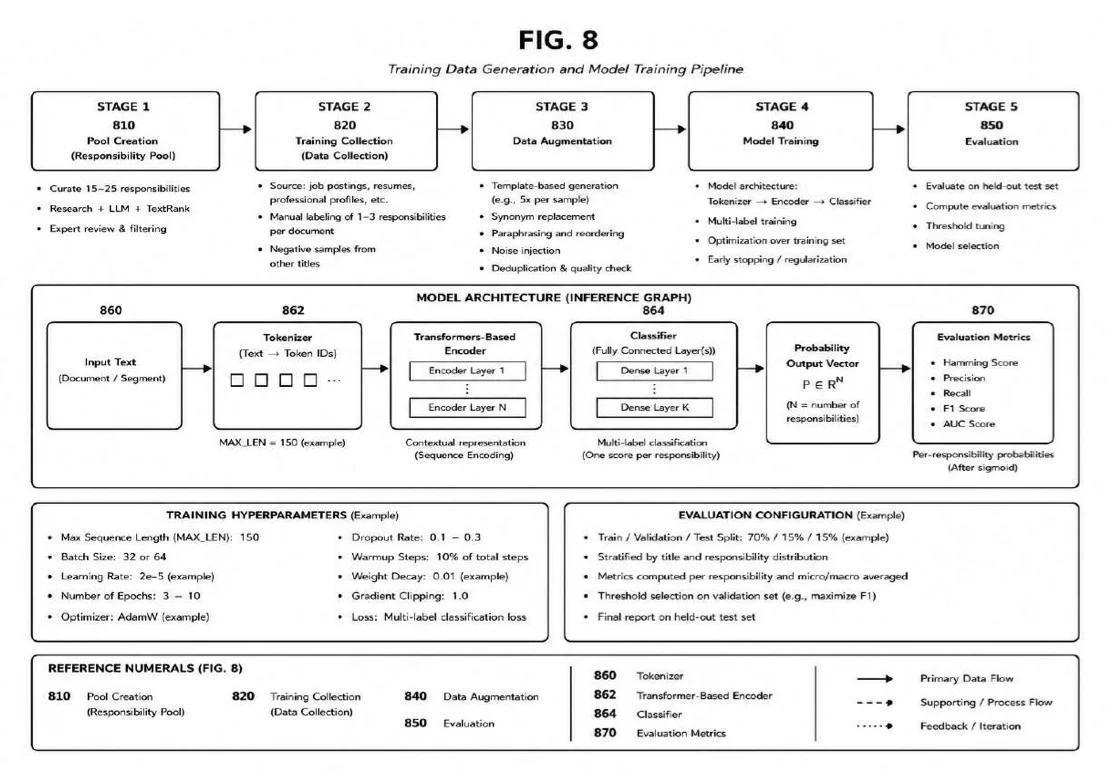
[0022]FIG. 8 is a flowchart illustrating the training data generation and model training pipeline for a title-specific responsibility prediction model, in accordance with an embodiment of the present invention.
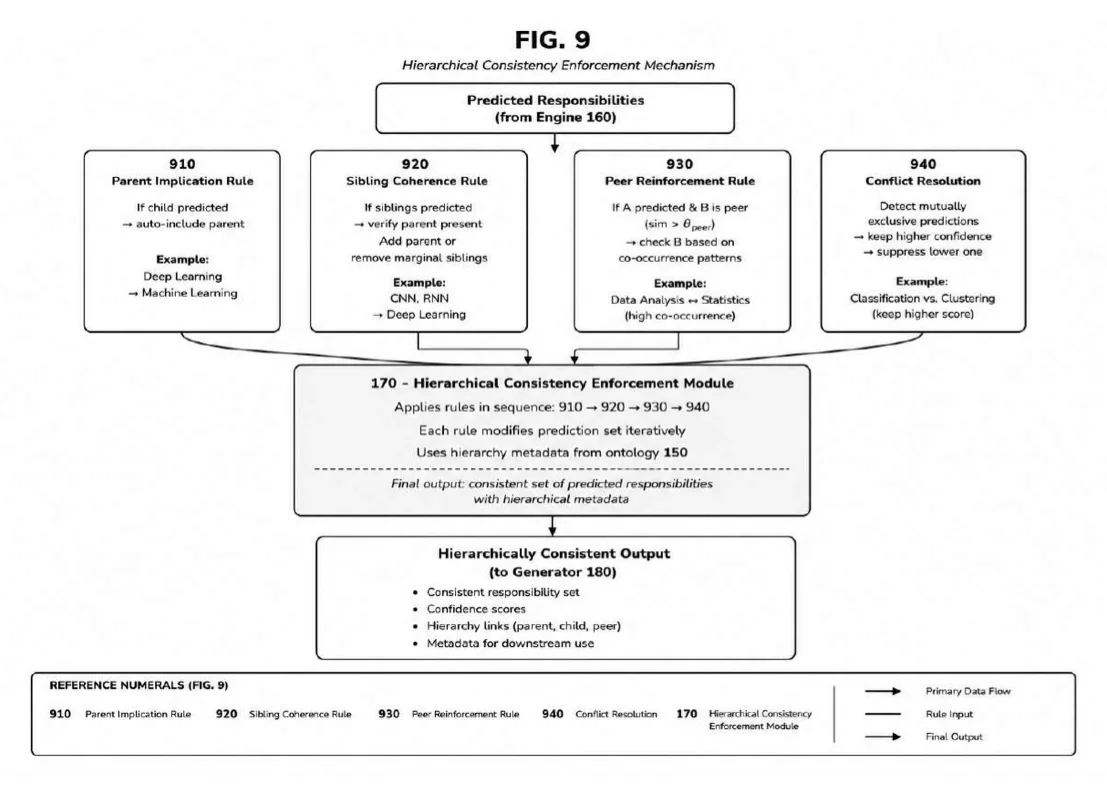
[0023]FIG. 9 is a schematic diagram illustrating the hierarchical consistency enforcement mechanism, in accordance with an embodiment of the present invention.
[0024]FIG. 10 is a chart illustrating exemplary performance metrics for title-specific responsibility prediction models, in accordance with an embodiment of the present invention.
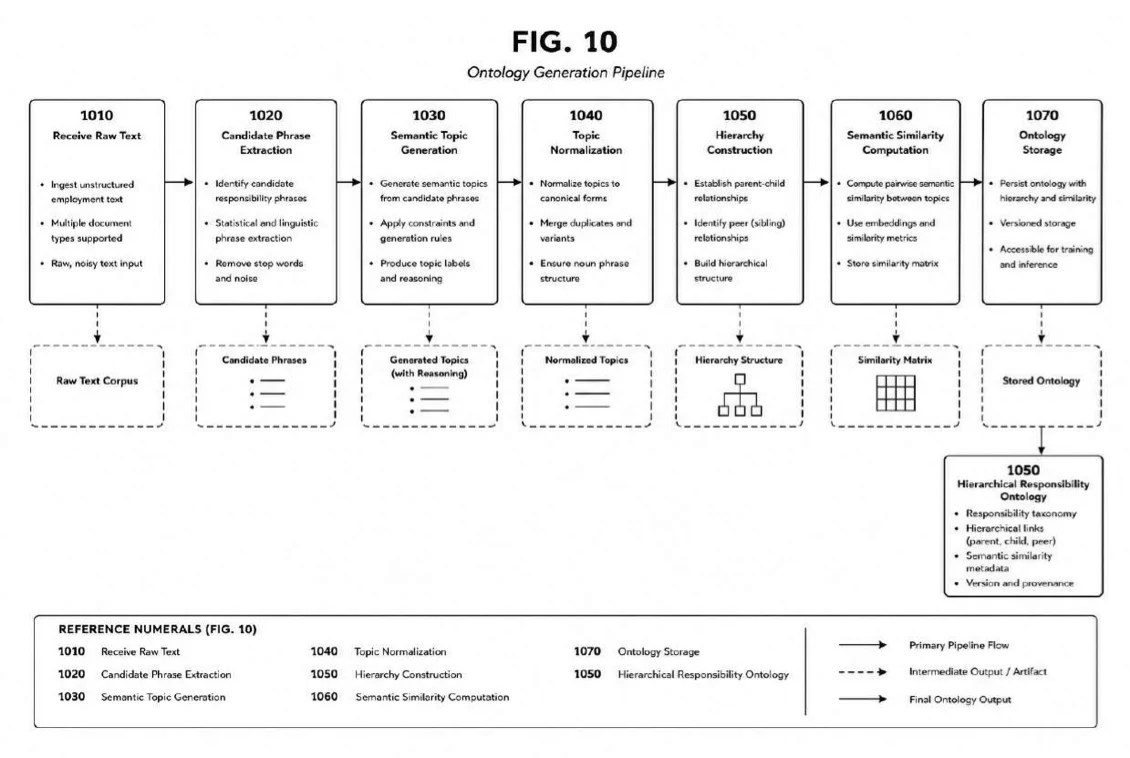
[0025]FIG. 10 is a flowchart illustrating the ontology generation pipeline from unstructured text to hierarchical taxonomy, in accordance with an embodiment of the present invention.
Detailed Specification
[0026]The present invention will now be described more fully hereinafter with reference to the accompanying drawings, in which preferred embodiments of the invention are shown. This invention may, however, be embodied in many different forms and should not be construed as limited to the embodiments set forth herein. Rather, these embodiments are provided so that this disclosure will be thorough and complete, and will fully convey the scope of the invention to those skilled in the art. Like numbers refer to like elements throughout.
I. SYSTEM ARCHITECTURE OVERVIEW
[0027]Referring to FIG. 1, the system 100 for extracting structured professional responsibilities from unstructured employment documents comprises several interconnected modules operating in a coordinated manner. The system 100 includes a document ingestion module 110, a text preprocessing module 120, an ontology generation pipeline 130, a feature extraction module 140, a hierarchical responsibility ontology 150, an adaptive multi-label prediction engine 160, a hierarchical consistency enforcement module 170, a structured output generator 180, and a multi-model deployment infrastructure 190.
[0028]The document ingestion module 110 is configured to receive unstructured employment documents from various sources, including but not limited to: uploaded resume files (PDF, DOCX, TXT formats), scraped job posting data from online platforms, manually entered job descriptions, and imported performance review documents. The ingestion module 110 performs initial format detection, encoding normalization (converting to UTF-8), and basic text extraction to produce raw text content.
[0029]The text preprocessing module 120 receives raw text from the ingestion module 110 and performs segmentation of the document into individual responsibility-bearing text units. For resume documents, this involves identifying bullet-pointed experience entries, typically denoted by bullet point dots, dashes, or line changes within experience sections. For job descriptions, the module identifies responsibility statements, requirements, and qualifications sections. The preprocessing module 120 also performs text normalization including: special character handling (preserving meaningful characters while removing artifacts), case normalization, whitespace standardization, and duplicate entry detection and removal.
II. ONTOLOGY GENERATION PIPELINE
[0030]The ontology generation pipeline 130 represents a core innovation of the present invention, transforming raw unstructured employment text into a structured hierarchical taxonomy. Referring to FIG. 11, the pipeline 130 comprises a candidate phrase extraction stage 1120, a semantic topic generation stage 1130, a topic normalization stage 1140, a hierarchy construction stage 1150, a semantic similarity computation stage 1160, and an ontology storage stage 1170.
[0031]At stage 1120, candidate phrase extraction receives preprocessed text segments from the text preprocessing module 120 and applies statistical keyword extraction algorithms including TextRank 512 and RAKE 514 (Rapid Automatic Keyword Extraction). The TextRank algorithm 512 constructs a word graph from the document text, where nodes represent words and edges represent co-occurrence relationships within a defined window size. The algorithm iteratively ranks words based on graph centrality measures, extracting the highest-ranked n-grams as candidate responsibility topics. The RAKE algorithm 514 identifies keyword candidates by analyzing word co-occurrence and word frequency, scoring phrases based on degree-to-frequency ratio. The output of stage 1120 is a ranked list of candidate responsibility phrases with associated importance scores.
[0032]At stage 1130, semantic topic generation receives the ranked candidate phrases from stage 1120 and processes them through a large language model 522 (e.g., GPT-4, Claude, or equivalent transformer-based generative model). The LLM 522 performs topic filtering, deduplication, and generalization according to parameterized constraints: the target label count parameter 524 (denoted as n) specifies the desired number of output topics; the noun phrase constraint 526 requires all outputs to be 1-3 word noun phrases suitable for resume bullet points; and the mutual exclusivity constraint 528 ensures topics are non-overlapping and collectively exhaustive. The LLM 522 outputs cleaned topics 529 along with keep/drop reasoning 521 explaining why certain candidates were retained or discarded.
[0033]At stage 1150, hierarchy construction receives the cleaned topics from stage 1140 and constructs parent-child relationships 532 between responsibility nodes. Even a two-level hierarchy adds significant semantic structure to the extraction process. For example, "Deep Learning" 262 is established as a child of "Machine Learning" 264, which is itself a child of "Artificial Intelligence" 266. Peer relationships 535 are established between responsibilities that frequently co-occur but lack hierarchical dependency. Semantic similarity metrics 537 are computed using pre-trained language model embeddings (e.g., sentence-transformers) and cosine similarity.
[0034]At stage 1160, semantic similarity computation 537 computes pairwise semantic similarity between all responsibility pairs using embeddings and similarity metrics, storing the similarity matrix for downstream use. At stage 1170, the hierarchical responsibility ontology 150 is persisted with hierarchy and similarity data in versioned storage accessible for training and inference. Referring to FIG. 11, the ontology generation pipeline from unstructured text to hierarchical taxonomy is illustrated in detail. At step 1110, raw unstructured employment text is received. At step 1120, candidate phrase extraction is applied using TextRank 512 and RAKE 514 algorithms to extract candidate responsibility phrases. At step 1130, the large language model 522 processes candidate phrases with parameters including target label count 524, noun phrase constraint 526, and mutual exclusivity constraint 528. At step 1140, the LLM outputs cleaned topics 529 with keep/drop reasoning 521. At step 1150, hierarchical relationships are constructed establishing parent-child links 532 and peer relationships 535. At step 1160, semantic similarity metrics 537 are computed for all responsibility pairs. At step 1170, the hierarchical responsibility ontology 150 is stored in a versioned data structure.
III. HIERARCHICAL RESPONSIBILITY ONTOLOGY
[0035]Referring to FIG. 2, the hierarchical responsibility ontology 150 comprises a multi-level taxonomy structure 200 that organizes professional responsibilities into semantically meaningful hierarchies. The ontology 150 is stored in a non-transitory computer-readable medium and is structured as a directed acyclic graph (DAG) with the following properties.
[0036]At the highest level (Level 0), the ontology 150 defines broad professional domains such as "Technology" 210, "Finance" 220, "Marketing" 230, "Healthcare" 240, and "Operations" 250. Each domain branches into functional areas (Level 1), such as "Data Science" 212 under "Technology" 210 or "Investment Analysis" 222 under "Finance" 220.
[0037]At Level 2, functional areas decompose into activity clusters representing coherent sets of professional activities. For example, under "Data Science" 212, activity clusters include "Machine Learning" 214, "Data Engineering" 216, "Statistical Analysis" 218, and "Visualization" 219.
[0038]At Level 3, the finest granularity, reside specific responsibilities—noun phrases of 2-3 words that summarize individual job description bullet points or resume entries. These responsibilities are curated to: (a) exclude tools and specific tasks (e.g., "Python", "AWS", "Excel"); (b) be specific to the job title rather than overly general competencies (e.g., "collaboration" or "communication" are excluded unless they are core responsibilities); and (c) maintain similar granularity within each target title's responsibility pool.
[0039]The ontology 150 further defines three types of relationships between responsibility nodes.
[0040]Parent-child relationships (is-a) 260: If responsibility A is a specialization of responsibility B, then A is a child of B. For example, "Deep Learning" 262 is a child of "Machine Learning" 264, which is a child of "Artificial Intelligence" 266. These relationships are represented as directed edges in the DAG with weights indicating the strength of the specialization.
[0041]Peer relationships (related-to) 270: Responsibilities that frequently co-occur in professional contexts but do not have a hierarchical relationship are connected by peer edges. For example, "Feature Engineering" 272 and "Model Development" 274 are peers under the "Machine Learning" 264 parent.
[0042]Semantic similarity metrics 280: Each pair of responsibilities in the ontology 150 has an associated semantic similarity score 282 computed using pre-trained language model embeddings (e.g., sentence-transformers) and cosine similarity. These scores enable soft clustering and nearest-neighbor-based responsibility recommendations.
[0043]The ontology 150 is maintained in a versioned data structure with the following attributes for each responsibility node: unique identifier, display name, parent node references, child node references, peer node references, semantic embedding vector, target title associations, and version status (active/deprecated).
IV. FEATURE EXTRACTION MODULE
[0044]The feature extraction module 140 employs a transformer-based neural network, specifically a distilled bidirectional encoder representation model (DistilBERT) 142, to generate contextual embeddings from preprocessed document text segments. The module 140 operates as follows.
[0045]The tokenizer component 144 receives a text segment (e.g., a single resume bullet point) and converts it into a sequence of token identifiers using a pre-trained tokenizer vocabulary. The tokenizer 144 applies the following processing: addition of special tokens ([CLS] at the beginning, [SEP] at the end), truncation to a maximum sequence length (MAX_LEN = 150 tokens), padding to uniform length, and sliding window processing with a stride (STRIDE = 50 tokens) for text segments exceeding the maximum length.
[0046]For text segments longer than MAX_LEN tokens, the sliding window mechanism divides the text into overlapping windows. Each window is processed independently through the encoder, and the resulting embeddings are aggregated. The overflow-to-sample mapping tracks which windows correspond to which original text segment, enabling proper reassembly of predictions.
[0047]The encoder component 146 comprises a DistilBERT backbone with configurable layer freezing. During training, the system supports selective unfreezing of the top N transformer layers (num_layers_to_unfreeze parameter) while keeping lower layers frozen, enabling efficient fine-tuning. The encoder 146 outputs a hidden state tensor of shape (batch_size, sequence_length, hidden_size) where hidden_size = 768 for the base DistilBERT model.
[0048]The pooler component 148 extracts the [CLS] token representation (hidden_state[:, 0]) as the document segment embedding. This 768-dimensional vector is then passed through a pre-classifier linear layer (768 → n_dim, where n_dim = 128) with Tanh activation and dropout (drpt_pct = 0.1), producing a condensed representation suitable for multi-label classification.
V. ADAPTIVE MULTI-LABEL PREDICTION ENGINE
[0049]Referring to FIG. 4, the adaptive multi-label prediction engine 160 represents a core innovation of the present invention. Unlike conventional multi-label classifiers that apply a fixed threshold (e.g., 0.5) across all classes and all documents, the engine 160 dynamically computes optimal classification thresholds for each document based on multiple factors.
[0050]The engine 160 comprises a probability scoring module 152, a threshold adapter 154, a threshold application module 156, and a confidence analyzer 440.
[0051]The probability scoring module 152 receives the condensed feature representation from the pooler 148 and computes raw logits through a classifier linear layer (n_dim → NUM_LABEL, where NUM_LABEL equals the size of the title-specific responsibility pool, typically 15-25 responsibilities). These logits are transformed into probability scores via the sigmoid function 412, producing a vector of independent probabilities p_i in [0, 1] for each responsibility i in the pool.
[0052]The threshold adapter 154 implements the adaptive thresholding mechanism. For each input document, the adapter 154 computes a document-specific threshold based on the following factors.
[0053]Factor 1 (score distribution analyzer 422): The adapter 154 analyzes the full probability distribution across all responsibilities in the pool. It computes statistics including mean probability, standard deviation, maximum probability, and the gap between the top-k probabilities and the remainder. Documents with a clear separation between high-confidence and low-confidence predictions receive more aggressive (higher) thresholds, while documents with flat distributions receive more permissive (lower) thresholds.
[0054]Factor 2 (title prior estimator 424): The adapter 154 maintains learned prior distributions for each target title based on training data statistics. For example, a "Data Scientist" document typically exhibits high probabilities for "Machine Learning" and "Data Analysis," while a "Marketing" document shows high probabilities for "Content Creation" and "Social Media Management." The adapter 154 uses these priors to calibrate thresholds—responsibilities that are common for the target title have their thresholds slightly raised (to reduce false positives among common labels), while rare responsibilities have their thresholds lowered (to improve recall for specialized skills).
[0055]Factor 3 (document characteristics analyzer 426): The adapter 154 considers the length of the input document (number of text segments, total word count) as a proxy for information completeness. Longer, more detailed documents support higher thresholds because they contain more evidence for each predicted responsibility. Brief documents receive lower thresholds to avoid missing responsibilities that may be implied but not explicitly stated.
[0056]Factor 4 (historical performance analyzer 428): The adapter 154 incorporates historical precision-recall metrics for each responsibility class from validation data. Responsibilities with historically high precision (low false positive rate) can use lower thresholds, while responsibilities prone to false positives have their thresholds raised.
[0057]The threshold adapter 154 combines these factors using a weighted scoring function:
θ_doc = α·θ_dist + β·θ_prior + γ·θ_len + δ·θ_perf
where α, β, γ, δ are learned coefficients 429 optimized on validation data to maximize the overall F1 score.
[0058]The threshold application module 156 applies the computed adaptive threshold θ_doc to the probability scores, generating a binary prediction mask:
prediction_i = 1 if p_i ≥ θ_doc · w_i else 0
where w_i is a per-responsibility weight factor 432 learned during training to account for class imbalance.
[0059]The confidence analyzer 440 computes additional confidence metrics for each predicted responsibility, including: absolute probability score 442, relative rank within the document's predictions 444, distance from the adaptive threshold 446, and semantic consistency score 448 (measuring how well the prediction aligns with the hierarchical ontology structure).
VI. HIERARCHICAL CONSISTENCY ENFORCEMENT
[0060]Referring to FIG. 9, the hierarchical consistency enforcement module 170 ensures that the final output respects the semantic relationships defined in the ontology 150. The module 170 operates through the following mechanisms.
[0061]Parent implication rule 910: If a child's responsibility is predicted with confidence above threshold, the system automatically includes the corresponding parent responsibility in the output, even if the parent's independent probability is below threshold. This ensures ontological coherence—for example, predicting "Deep Learning" implies "Machine Learning" and "Artificial Intelligence."
[0062]Sibling coherence rule 920: If multiple sibling responsibilities (sharing the same parent) are predicted, the system verifies that the parent is also predicted. If the parent is missing, the system either: (a) adds the parent to the output, or (b) removes the siblings if their confidence is marginal, depending on a learned policy.
[0063]Peer reinforcement rule 930: If responsibility A is predicted and responsibility B is a peer of A with high semantic similarity (similarity score > 0.85), the system checks whether B should also be predicted based on co-occurrence patterns from training data.
[0064]Conflict resolution 940: The module 170 detects and resolves prediction conflicts where mutually exclusive responsibilities (as defined in the ontology) are both predicted. The conflict is resolved by keeping the higher-confidence prediction and suppressing the lower-confidence one.
VII. STRUCTURED OUTPUT GENERATOR
[0065]The structured output generator 180 produces machine-readable responsibility profiles in a standardized format. Each profile comprises: predicted responsibilities (a list of responsibility names from the title-specific pool, sorted by confidence score in descending order); top-1 responsibility (the highest-confidence predicted responsibility, serving as a primary classification); probability list (a complete vector of probability scores for all responsibilities in the pool, enabling downstream applications to apply custom thresholds or perform comparative analysis); hierarchical metadata (for each predicted responsibility, parent node references, child node references, and depth level within the ontology); and confidence metrics (per-responsibility confidence scores, relative ranks, and semantic consistency indicators).
[0066]The output format is JSON-compatible, supporting both single-document inference (returning a single profile object) and batch inference (returning a list of profile objects). For documents processed with sliding windows, the generator 180 aggregates predictions across windows using maximum probability fusion—taking the maximum probability for each responsibility across all windows of the same document.
VIII. MULTI-MODEL DEPLOYMENT ARCHITECTURE
[0067]Referring to FIG. 6, the multi-model deployment infrastructure 190 enables scalable, title-specific inference across multiple professional domains. The infrastructure 190 comprises: a model repository 610 storing trained model parameters (.pth files) for each target title, along with corresponding responsibility pool definitions, tokenizer configurations, and metadata files; a model selection module 620 routing incoming inference requests to the appropriate title-specific model based on either explicit user specification or automatic title detection; a cloud inference endpoint 630 implemented using a cloud-based machine learning platform (e.g., AWS SageMaker) providing a REST API for model inference; and a prediction aggregation module 640 combining predictions from multiple text segments of a single document using maximum probability fusion.
[0068]The inference pipeline follows a standardized function interface comprising: model_fn(model_dir) loading the trained model from the specified directory; input_fn(request_body, request_content_type) parsing incoming JSON requests; predict_fn(input_object, model) processing batches through the tokenizer and model; and output_fn(prediction, content_type, context) aggregating predictions and formatting structured responsibility profiles.
[0069]Referring to FIG. 7, the responsibility pool structure 700 for a representative target job title is illustrated. For the "Data Scientist" title 710, the responsibility pool 720 comprises 15-25 curated responsibilities including "Machine Learning" 722, "Deep Learning" 724, "Feature Engineering" 726, "Model Development" 728, "Data Visualization" 730, "Statistical Analysis" 732, "Data Mining" 734, "A/B Testing" 736, "Data Pipeline" 738, and "Natural Language Processing" 740. Each responsibility has associated hierarchical metadata 750 linking it to parent and child nodes in the ontology 150.
IX. TRAINING PIPELINE
[0070]Referring to FIG. 8, the training pipeline 800 for a title-specific responsibility prediction model comprises the following stages.
[0071]Responsibility pool curation 810: For each target title, a responsibility pool of 15-25 responsibilities is curated through a multi-step process: (1) responsibility brainstorming via domain research, large language model prompting, and TextRank keyword summarization of job postings; (2) filtering and refinement to ensure responsibilities satisfy the noun phrase, specificity, and granularity criteria; (3) domain expert consultation to validate and improve the pool; and (4) frequency filtering during training data collection to remove responsibilities appearing fewer than 3-5 times.
[0072]Training data collection 820: Real training samples are collected by manually labeling responsibilities on job descriptions and resumes from online platforms (LinkedIn, Indeed, etc.). Each sample consists of a text segment (bullet point) and 1-3 associated responsibility labels. Negative samples are included—text segments from other target titles with no relevant responsibilities, labeled with a zero vector—to reduce false positives.
[0073]Data augmentation 830: Each real training sample is augmented using template-based generation to produce 5 additional synthetic samples, increasing dataset diversity while maintaining label integrity. The augmented samples are quality-monitored to ensure they preserve the semantic meaning of the original labels.
[0074]Post-processing 840: The training dataset undergoes typo correction, case normalization, duplicate removal, and label distribution analysis. The system prefers balanced label distributions, and underrepresented responsibilities are boosted through additional data collection or targeted augmentation.
[0075]Model training 850: The DistilBERT-based model is trained using binary cross-entropy loss computed independently for each responsibility label. The loss function handles the multi-label nature of the task by treating each label as an independent binary classification problem. The model architecture comprises a tokenizer 860 converting text to token IDs, a transformer-based encoder 862 generating contextual representations, and a classifier 864 with fully connected layers producing a probability output vector. Training hyperparameters include: learning rate, batch size, number of epochs, dropout percentage, layer unfreezing strategy, and initialization type (Xavier, normalized Xavier, or random).
[0076]Evaluation 850: Model performance is evaluated using: Hamming score (measuring exact label set match rate), overall F1 score, overall AUC score, and per-responsibility precision, recall, F1, and AUC scores. The evaluation distinguishes between responsibilities with high support (frequent in test data) and low support (rare responsibilities), ensuring the model performs well across the full responsibility spectrum.
X. EXEMPLARY PERFORMANCE
[0077]Exemplary performance metrics for title-specific responsibility prediction models are illustrated below.
[0078]For the "Accountant" title (19 responsibilities, 530 total samples), the system achieves an overall F1 score of 0.906 and an overall AUC of 0.987. Individual responsibility F1 scores range from 0.571 (for low-support responsibilities like "Data Analysis" with 3 samples) to 1.000 (for well-represented responsibilities like "Bank Reconciliations" and "Cash Management").
[0079]For the "Marketing" title (15 responsibilities, 552 total samples), the system achieves an overall F1 score of 0.739 and an overall AUC of 0.967. The model demonstrates strong performance on clearly defined responsibilities (e.g., "Social Media Management" F1 = 0.909, "SEO/SEM" F1 = 1.000) while showing lower performance on ambiguous or overlapping responsibilities (e.g., "Content Creation" F1 = 0.650, "Marketing Analysis" F1 = 0.400).
[0080]For the "Investment Banking Analyst" title (19 responsibilities), the system achieves an overall F1 score of 0.794 and an overall AUC of 0.976. High-performance responsibilities include "Due Diligence" (F1 = 1.000), "Industry Research" (F1 = 0.933), and "Trading Support" (F1 = 0.933), while lower performance is observed on responsibilities with limited training data such as "Business Development" (F1 = 0.375).
[0081]For each responsibility the F1 score distribution demonstrates strong performance on well-defined responsibilities and acceptable performance on rare or nuanced responsibilities.
XI. END-TO-END METHOD
[0082]Referring to FIG. 3, the end-to-end method 300 for extracting structured professional responsibilities begins at step 310 with receiving an unstructured employment document. At step 320, the document is segmented into individual responsibility-bearing text units. At step 330, a hierarchical responsibility ontology is generated through n-gram summarization, large language model-based topic generation and filtering, and hierarchical relationship construction. At step 340, contextual embeddings are generated for each text unit using a transformer-based encoder. At step 350, responsibility probability scores are computed using a title-specific multi-label classifier. At step 360, adaptive classification thresholds are determined based on the distribution of probability scores. At step 370, the adaptive thresholds are applied to generate predicted responsibilities. At step 380, hierarchical consistency is enforced by ensuring predicted child responsibilities imply corresponding parent responsibilities. At step 390, a structured responsibility profile is generated comprising predicted responsibilities, confidence scores, and hierarchical relationships.
XII. EXEMPLARY USE CASES AND INDUSTRIAL APPLICABILITY
[0083]The system of the present invention supports a broad spectrum of downstream applications across multiple industries, demonstrating substantial industrial applicability and commercial value.
A. Human Resources and Talent Acquisition
In the human resources industry, the invention enables automated candidate screening at scale. By extracting structured responsibility profiles from candidate resumes, recruiters can rapidly identify candidates whose experience aligns with position requirements without manual review of hundreds of applications. The hierarchical output allows recruiters to search for candidates not only by specific responsibilities (e.g., "deep learning") but also by broader competency areas (e.g., "machine learning" or "artificial intelligence"), enabling more flexible and intelligent candidate matching.
B. Professional Services and Consulting
Management consulting firms, legal services providers, accounting firms, and other professional services organizations can analyze thousands of job postings across industries to identify emerging responsibility trends, skill gaps in the market, and shifting client demands. By structuring unstructured job market data into machine-readable responsibility profiles, consulting firms can deliver data-driven insights to clients regarding workforce planning, organizational design, and talent strategy.
C. Compensation and Benefits Analysis
Compensation benchmarking platforms can utilize the invention to structure job descriptions into standardized responsibility profiles, enabling precise compensation comparisons across organizations, industries, and geographies. By extracting consistent responsibility data from millions of job postings, these platforms can correlate specific responsibilities with compensation levels and provide data-driven salary recommendations.
D. Workforce Development and Education
Educational institutions, corporate training departments, and workforce development agencies can leverage the invention to align curricula and training programs with actual market demand. By analyzing structured responsibility profiles extracted from current job postings, these organizations can identify which responsibilities are in high demand, which are declining, and which emerging responsibilities represent new opportunities.
E. Job Market Analytics and Economic Research
Government labor agencies, economic research institutions, and market intelligence providers can utilize the invention to monitor structural changes in the labor market at scale. By extracting structured responsibility data from millions of job postings over time, these organizations can track the emergence of new professional roles, the evolution of existing roles, and the displacement of obsolete responsibilities.
XIII. COMPUTER-READABLE MEDIUM AND PROCESSING SYSTEM
[0089]The present invention may be embodied as systems, methods, and/or computer program products. Accordingly, the present invention may take the form of an entirely hardware embodiment, an entirely software embodiment (including firmware, resident software, micro-code, etc.), or an embodiment combining software and hardware aspects that may all generally be referred to herein as a "circuit," "module," or "system." Furthermore, the present invention may take the form of a computer program product embodied in any tangible medium of expression having computer-usable program code embodied in the medium.
[0090]Any combination of one or more computer-usable or computer-readable media may be utilized. For example, a computer-readable medium may include one or more of: a portable computer diskette, a hard disk, a random access memory (RAM) device, a read-only memory (ROM) device, an erasable programmable read-only memory (EPROM or Flash memory), a portable compact disc read-only memory (CD-ROM), an optical storage device, and a magnetic storage device. Computer program code for carrying out operations of the present invention may be written in any combination of one or more programming languages, including an object-oriented programming language such as Java, Python, C++, or the like.
[0091]The present invention is described above with reference to flowchart illustrations and/or block diagrams of methods, apparatus (systems), and computer program products according to embodiments of the invention. It will be understood that each block of the flowchart illustrations and/or block diagrams, and combinations of blocks in the flowchart illustrations and/or block diagrams, can be implemented by computer program instructions. These computer program instructions may be provided to a processor of a general-purpose computer, special purpose computer, or other programmable data processing apparatus to produce a machine, such that the instructions, which execute via the processor of the computer or other programmable data processing apparatus, create means for implementing the functions/acts specified in the flowchart and/or block diagram block or blocks.
[0092]The computer program instructions may also be stored in a computer-readable medium that can direct a computer or other programmable data processing apparatus to function in a particular manner, such that the instructions stored in the computer-readable medium produce an article of manufacture including instruction means which implement the function/act specified in the flowchart and/or block diagram block or blocks.
[0093]The computer program instructions may also be loaded onto a computer or other programmable data processing apparatus to cause a series of operational steps to be performed on the computer or other programmable apparatus to produce a computer-implemented process such that the instructions which execute on the computer or other programmable apparatus provide processes for implementing the functions/acts specified in the flowchart and/or block diagram block or blocks.
Claims
- One or more non-transitory computer-readable media storing computer-executable instructions that, when executed by one or more processors, cause the one or more processors to: receive an unstructured employment document; identify responsibility-bearing text units within the employment document; generate a hierarchical responsibility ontology comprising a plurality of responsibility labels organized according to semantic relationships; generate contextual representations of the responsibility-bearing text units using a language representation model; determine confidence scores corresponding to the plurality of responsibility labels using a multi-label prediction model; determine one or more document-specific classification thresholds based on characteristics of the confidence scores and document-specific features; generate predicted responsibility labels by applying the one or more classification thresholds to the confidence scores; enforce hierarchical consistency among the predicted responsibility labels according to predefined semantic relationship rules; and generate a structured responsibility profile comprising the predicted responsibility labels and associated confidence information.
- The media of claim 1, wherein identifying the responsibility-bearing text units comprises applying one or more statistical, graph-based, linguistic, machine-learning, or artificial-intelligence-based phrase extraction techniques.
- The media of claim 1, wherein generating the hierarchical responsibility ontology comprises processing candidate semantic phrases using one or more language understanding models configured according to one or more semantic generation constraints comprising a target label count, phrase structure constraints, and semantic redundancy constraints.
- The media of claim 1, wherein generating the hierarchical responsibility ontology further comprises establishing hierarchical parent-child relationships and semantic peer relationships among responsibility labels according to semantic similarity and co-occurrence characteristics.
- The media of claim 1, wherein determining the one or more document-specific classification thresholds comprises evaluating one or more of: a distribution of the confidence scores, title-specific prior information, document completeness characteristics, document length characteristics, and historical prediction performance.
- The media of claim 1, wherein enforcing hierarchical consistency comprises: automatically including one or more parent responsibility labels when corresponding child responsibility labels are predicted; verifying semantic consistency among sibling responsibility labels; reinforcing semantically related responsibility labels according to similarity relationships; and resolving conflicting responsibility predictions.
- The media of claim 1, wherein the computer-executable instructions further cause the one or more processors to deploy one or more title-specific prediction models through a distributed inference infrastructure configured to select an appropriate prediction model based on characteristics of the employment document.
- A computer-implemented method comprising: receiving an unstructured employment document; identifying responsibility-bearing text units; generating a hierarchical responsibility ontology from semantic information extracted from the employment document; generating contextual representations of the responsibility-bearing text units; determining confidence scores corresponding to a plurality of responsibility labels; determining one or more document-specific classification thresholds; generating predicted responsibility labels; enforcing hierarchical consistency among the predicted responsibility labels; and generating a structured responsibility profile.
- The method of claim 8, wherein identifying the responsibility-bearing text units comprises applying one or more statistical, graph-based, linguistic, machine-learning, or artificial-intelligence-based extraction techniques.
- The method of claim 8, wherein generating the hierarchical responsibility ontology comprises: processing candidate semantic phrases using one or more language understanding models configured according to semantic generation constraints; and generating normalized responsibility labels together with explanatory metadata indicating whether candidate phrases were retained or discarded.
- The method of claim 8, wherein determining the one or more document-specific classification thresholds comprises combining multiple threshold adjustment factors including: a confidence score distribution factor, a title-specific prior factor, a document characteristic factor, and a historical prediction performance factor.
- The method of claim 8, wherein the multi-label prediction model independently generates confidence scores for each responsibility label within a responsibility ontology.
- A computing system comprising: memory storing computer-executable instructions; and one or more processors configured to execute the computer-executable instructions to: receive an unstructured employment document; generate a hierarchical responsibility ontology comprising semantically related responsibility labels; generate contextual representations of responsibility-bearing text units; determine confidence scores for a plurality of responsibility labels using a multi-label prediction model; determine document-specific classification thresholds; generate predicted responsibility labels; enforce hierarchical consistency among the predicted responsibility labels; and generate a machine-readable responsibility profile comprising predicted responsibility labels and associated metadata.
- The computing system of claim 13, wherein the hierarchical responsibility ontology is stored as a graph data structure comprising nodes representing responsibility labels and edges representing semantic relationships among the responsibility labels.
- The computing system of claim 13, wherein the computer-executable instructions further cause the one or more processors to: maintain a plurality of prediction models corresponding to different employment domains or job titles; select one of the plurality of prediction models based on characteristics of the received employment document; and aggregate prediction outputs generated from multiple portions of the employment document to produce the structured responsibility profile.